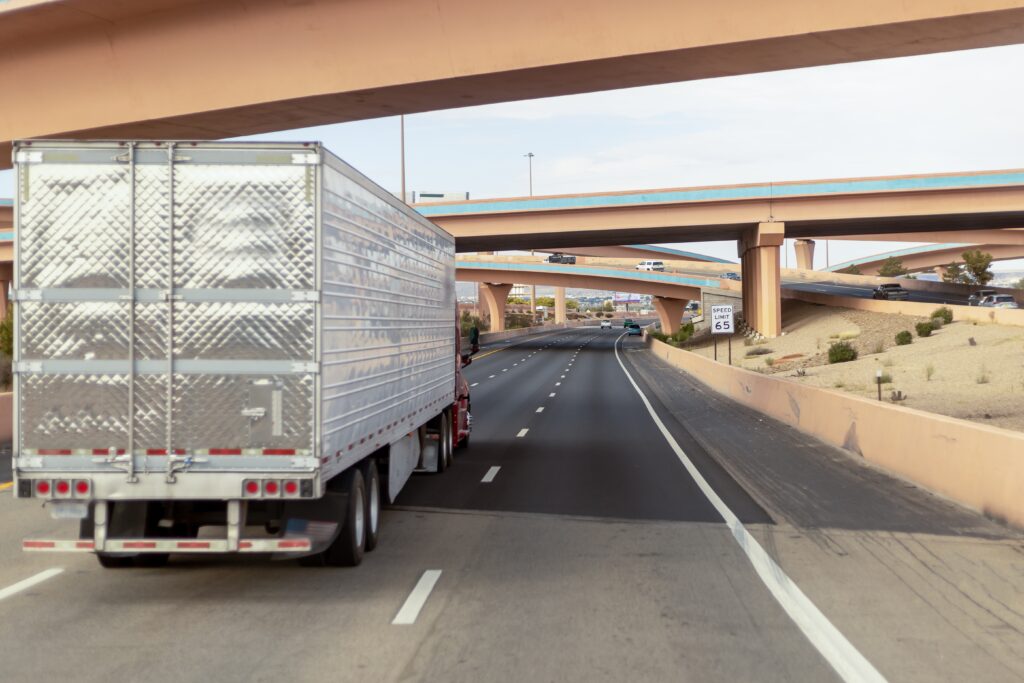
Interstate 84 is the main artery connecting Boise, Meridian, Nampa, and the broader Treasure Valley to the rest of the Northwest. It carries an enormous volume of commercial truck traffic every day, semis hauling freight from Portland to Salt Lake City, box trucks making regional deliveries, and oversized loads moving through the corridor at all hours. For most drivers, I-84 feels familiar and manageable. But for people who have been injured or even killed on this stretch of interstate, it feels daunting and dangerous.
This post explains why I-84 near Boise produces so many serious and fatal truck crashes, what the recurring danger patterns look like, and what you should do if you or someone you love has been hurt. If you are already past the questions and looking for help, our truck accident attorneys at Litster Frost Injury Lawyers are available now. Call (208) 333-3366 for a free consultation.
Why I-84 Near Boise Is a High-Risk Corridor for Truck Crashes
I-84 through the Treasure Valley was not originally designed for the traffic volume it carries today. The Boise metro area has grown faster than its infrastructure, and the stretch of I-84 running from Nampa through Meridian and past Boise Airport combines several factors that make it particularly dangerous when large commercial vehicles are involved.
Traffic volume is heavy during morning and evening commutes, with passenger vehicles and commercial trucks sharing lanes in conditions that leave little margin for error. The highway passes through active construction corridors, features several short merge lanes and ramp transitions, and sees significant speed variation between trucks running at highway speed and vehicles entering or exiting the freeway. That combination creates the conditions for the kind of sudden, high-force crashes that trucks generate when things go wrong.
Recent I-84 Truck Crashes Show How Quickly Things Turn Deadly
Several serious and fatal crashes on I-84 near Boise in recent years illustrate how quickly conditions deteriorate when a commercial vehicle is involved.
Near the Boise Airport, a three-vehicle crash on westbound I-84 near the Vista exit resulted in a fatality after a passenger vehicle rear-ended a slowing semi-truck and then struck a second vehicle. The crash required extrication for two vehicles and closed westbound lanes for approximately two hours. The driver of a Volkswagen Atlas collided with the rear end of a semi-truck that had been slowing for a disabled motorist, and the driver later died from traumatic blunt force injuries sustained in the crash.
East of Mountain Home, a fatal wrong-way crash on I-84 near mile marker 102 resulted in a fiery head-on collision between a passenger truck and a semi. According to East Idaho News, a pickup truck traveling east in the westbound lanes struck a semi-truck and trailer head-on, causing both vehicles to erupt in flames. The pickup driver died at the scene and the semi driver was flown by air ambulance to a nearby hospital, with both westbound lanes blocked for roughly six and a half hours.
Near the Robinson Road overpass on westbound I-84, a rear-end crash involving a box truck turned fatal. According to Idaho News, a black pickup rear-ended a box truck at the Robinson Road overpass, and a seven-year-old passenger in the pickup died at the scene while three other occupants were transported to the hospital. ISP sought public witnesses and video footage as part of its ongoing investigation into the crash.
What These Recent Crashes Have in Common
Looking across these incidents, several patterns emerge consistently. Sudden slowdowns in heavy traffic where drivers have no time to react. Congestion near interchange points that compresses the space between vehicles. Limited escape routes when the lane configuration reduces options for evasive maneuver. In every case, the involvement of a large commercial vehicle whose size and weight transform what might be a survivable collision between two passenger cars into something far more serious.
The Most Dangerous Crash Pattern: Merges, Ramps, and Short On-Lanes
The most predictable danger zone on I-84 near Boise is wherever traffic is forced to merge. The on-ramps feeding I-84 from Meridian Road, Garrity Boulevard, Franklin Road, and the airport connector are short, and drivers entering the highway must reach freeway speed quickly while identifying a gap in lanes that may already be saturated with truck traffic.
Why Merge Lanes and Blind Spots Lead to Chain-Reaction Collisions
Commercial trucks have significant blind spots on both sides and directly behind the cab. A passenger vehicle entering the freeway on a short on-ramp may be completely invisible to a truck driver until the merge is already underway. When the truck cannot react in time, the collision happens at closing speeds that leave no margin for correction.
These merge-zone crashes frequently become chain-reaction events. A truck that brakes hard or swerves to avoid a merging vehicle creates a sudden obstacle for the vehicles behind it. Because trucks require significantly longer stopping distances than passenger cars, the driver behind the truck may not be able to stop before impact, pulling additional vehicles into the collision sequence.
Construction Zones on I-84 Increase Risk
Active construction on I-84 has been a persistent feature of the Boise corridor for years, and construction zones change the equation for every driver on the highway. Lane configurations shift, shoulders disappear, speed limits drop, and barriers narrow the travel lanes to dimensions that feel uncomfortably tight for a tractor-trailer running at posted speeds.
The danger is not just the physical narrowing of the road. It is the disruption of driver familiarity. Regular commuters develop muscle memory for the highway they drive every day. They know where the lanes are, where trucks tend to run, and where the merge points are.
Construction eliminates that familiarity overnight, replacing the expected layout with a new configuration that requires conscious attention at speeds where attention demands are already high.
Speed Differences Make Truck Collisions Worse Than Car Crashes
Many serious truck crashes on I‑84 begin with only a small mistake in speed or spacing. When a fully loaded semi is moving much faster than the traffic ahead of it or is simply following too closely, the basic physics of weight, speed, and stopping distance turn what could have been a minor incident into a life‑changing or fatal collision.
How Speed Differentials and Following Distance Turn Minor Errors Into Catastrophic Impacts
When a truck is moving faster than the traffic ahead of it or following too closely, a momentary lapse in attention can lead to life-altering injuries for the people in the smaller vehicle. What might have been a simple slowdown or near miss between two cars can become a violent rear-end collision that crushes the back of a passenger vehicle, causes severe head, neck, and spinal injuries, and, in the worst cases, takes a life.
In these situations, the truck driver’s speed choices and following distance often become central issues in holding the responsible parties accountable for the harm your family has suffered.
Box Trucks vs. Semis: Different Vehicles, Same Devastating Outcomes
Not every serious truck crash on I-84 involves a tractor-trailer. Box trucks, delivery vehicles, and other commercial vehicles cause serious and fatal crashes with regularity and are often given less attention in discussions about truck safety. A loaded box truck can weigh 26,000 pounds or more, and at highway speed it carries enough force to produce catastrophic injuries in a collision with a passenger vehicle. The regulatory framework for box truck drivers is also less stringent than for CDL holders operating semis, which can mean less training and less oversight behind the wheel.
What to Do After an I-84 Truck Crash in Boise
If you have been involved in a truck crash on I-84, the steps you take immediately afterward can significantly affect your ability to recover compensation. For a full breakdown of the post-crash process, our guide on what to do after a trucking accident covers each step in detail. The essentials are:
- Call 911 and ensure law enforcement responds and documents the scene.
- Seek medical attention immediately, even if you feel relatively uninjured.
- Photograph everything including vehicle positions, damage, road conditions, signage, and any visible injuries.
- Get contact information from witnesses before they leave the scene.
- Check for dashcam footage in your own vehicle and note any cameras on nearby infrastructure.
- Do not give a recorded statement to the trucking company's insurer before consulting an attorney.
- Contact Litster Frost Injury Lawyers as soon as possible at (208) 333-3366.
Evidence to Protect Early
Trucking companies are required to maintain black box data, electronic logging device records, driver qualification files, and maintenance logs, but these records are not preserved indefinitely. A formal legal demand to preserve evidence must go out immediately after a crash. GPS data, dispatch communications, and dashcam footage from the truck itself can disappear quickly if no preservation demand is made. The sooner an attorney is involved, the more of this evidence survives.
Your Legal Rights After a Boise I-84 Truck Crash
If a loved one was killed in an I-84 truck crash, your family may have the right to pursue a wrongful death claim that includes compensation for lost income, funeral expenses, loss of companionship, and in appropriate cases punitive damages.
Litster Frost Injury Lawyers have dedicated truck accident attorneys who represent injured victims and grieving families throughout the Treasure Valley.
When you work with our firm, we can:
- Send an immediate evidence preservation demand to the trucking company before black box data, driver logs, and dashcam footage are overwritten.
- Identify every liable party, including the driver, carrier, cargo loader, and maintenance contractor.
- Obtain and analyze electronic logging device records to determine whether hours-of-service violations contributed to the crash.
- Work with accident reconstruction specialists to establish exactly how the collision occurred.
- Handle all communications with commercial insurance carriers so you are not pressured into an inadequate settlement.
- Pursue every available source of compensation, including punitive damages where the evidence supports them.
- Take your case to trial if the insurer refuses to pay what your family deserves.
You can review our case results to see what our truck accident lawyers have recovered for clients in serious and fatal truck crash cases. Contact us at (208) 333-3366 for a free consultation.